
A Framework for Complex Problem-Solution Exploration
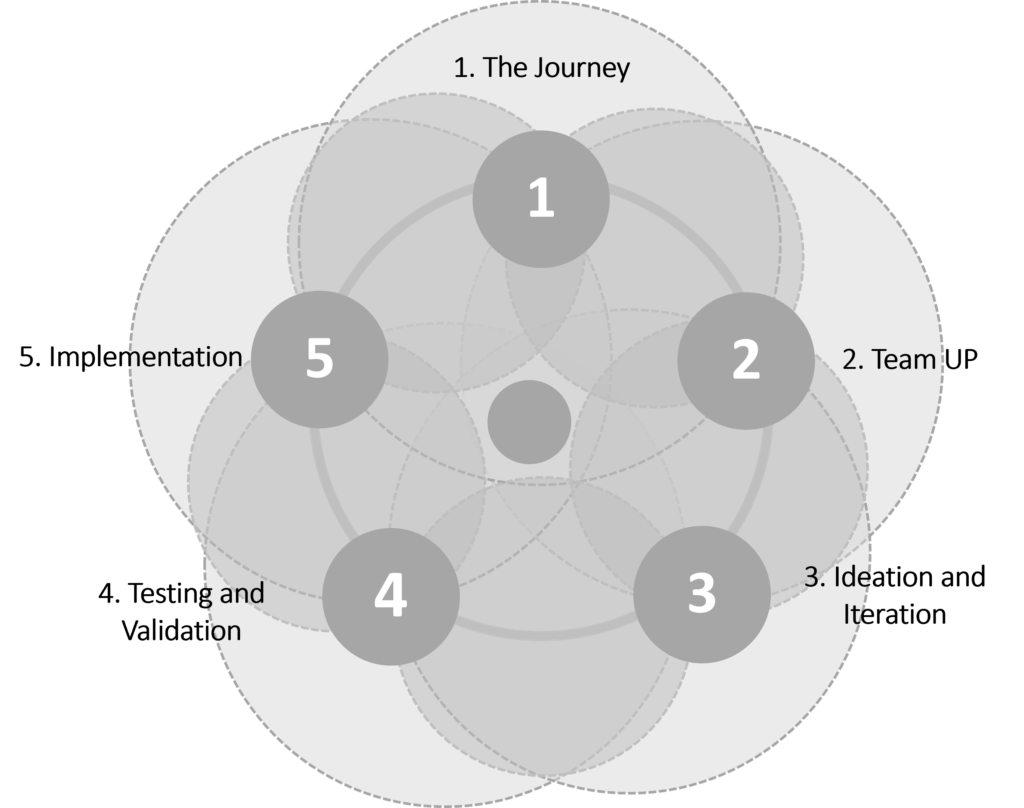
This five-stage framework is designed for exploring complex problems and their solution.
It follows an iterative process — within and across phases — where the project team revisits the different stages as new information and uncertainties emerge. The journey continues until the problem is sufficiently understood and clearly framed by the project team. This shared clarity creates the foundation for designing and implementing a solution that is simpler, more effective, and fit for purpose.
To keep the framework simple and intuitive, each stage outlines its specific goal, key activities, and expected deliverables. Supporting guiding questions help the project team adapt the model and determine the appropriate level of depth and scope research of each phase.
Please explore the detailed description of each phase below, together with the onboarding resources.
5 Phases
1. The Journey
Goal
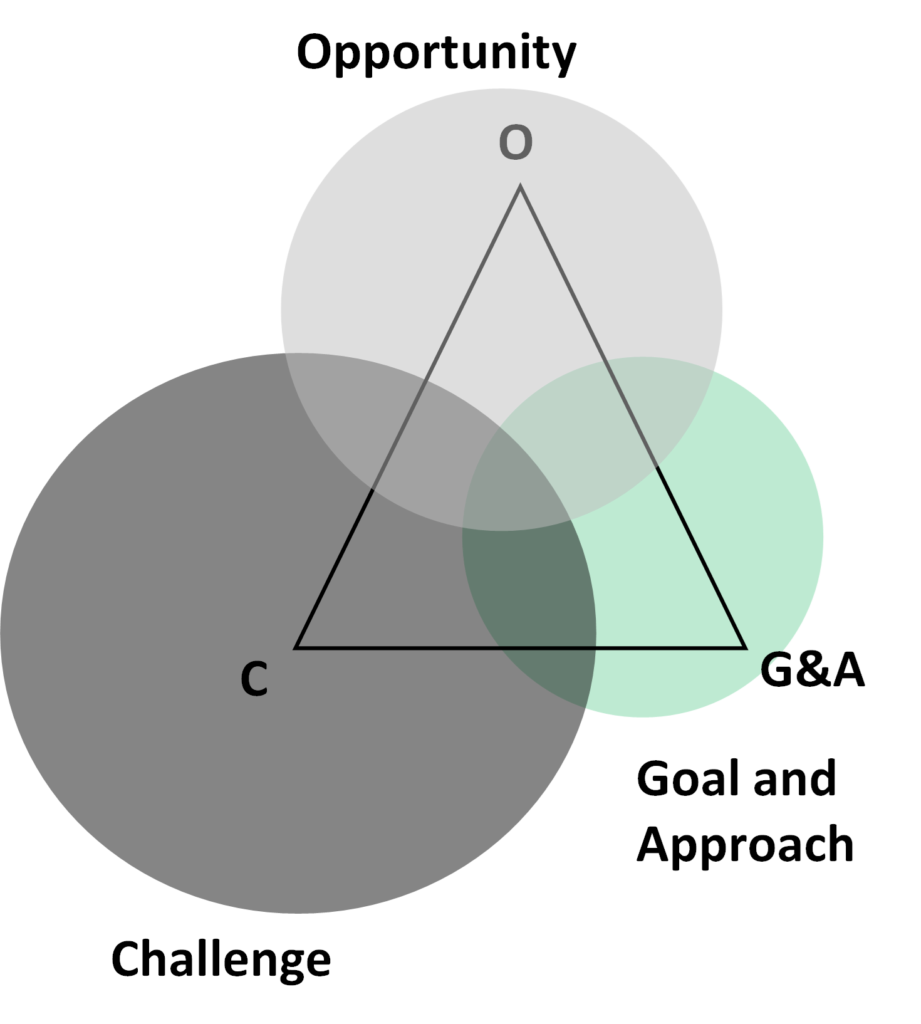
Define the starting journey for exploration, iteration, and collaboration to address the challenge and achieve the defined goal, while leveraging on the opportunities and within existing constraints.
Key Activities
1. Understand the challenge and further aspects for exploration
2. Understand the opportunity and current limitations
3. Goal and approach:
– Assess feasibility of partnerships and collective action
– Define the goal
– Adapt the SIJ to best overcome the challenge and maximize the opportunity in light of current limitations and resources
Deliverables
1. Problem statement and further topics for exploration
2. Opportunity statement and further topics for exploration
3. Goal and approach (SI Journey)
Detailed view and guidance questions
Download PDF
2. Team UP
Goal
Assemble a diverse team to support exploration, iteration, and collaboration throughout the journey,
Key Activities
1. Team onboarding
2. Team feedback on the “The Journey” and phase 1 results
3. Team alligment on next steps
Deliverables
1. Team onboarding
2. Adapted Journey
3. Best combination of team strenghts and division of work
Detailed view and guidance questions
Download PDF
3. Ideation and Iteration
Goal
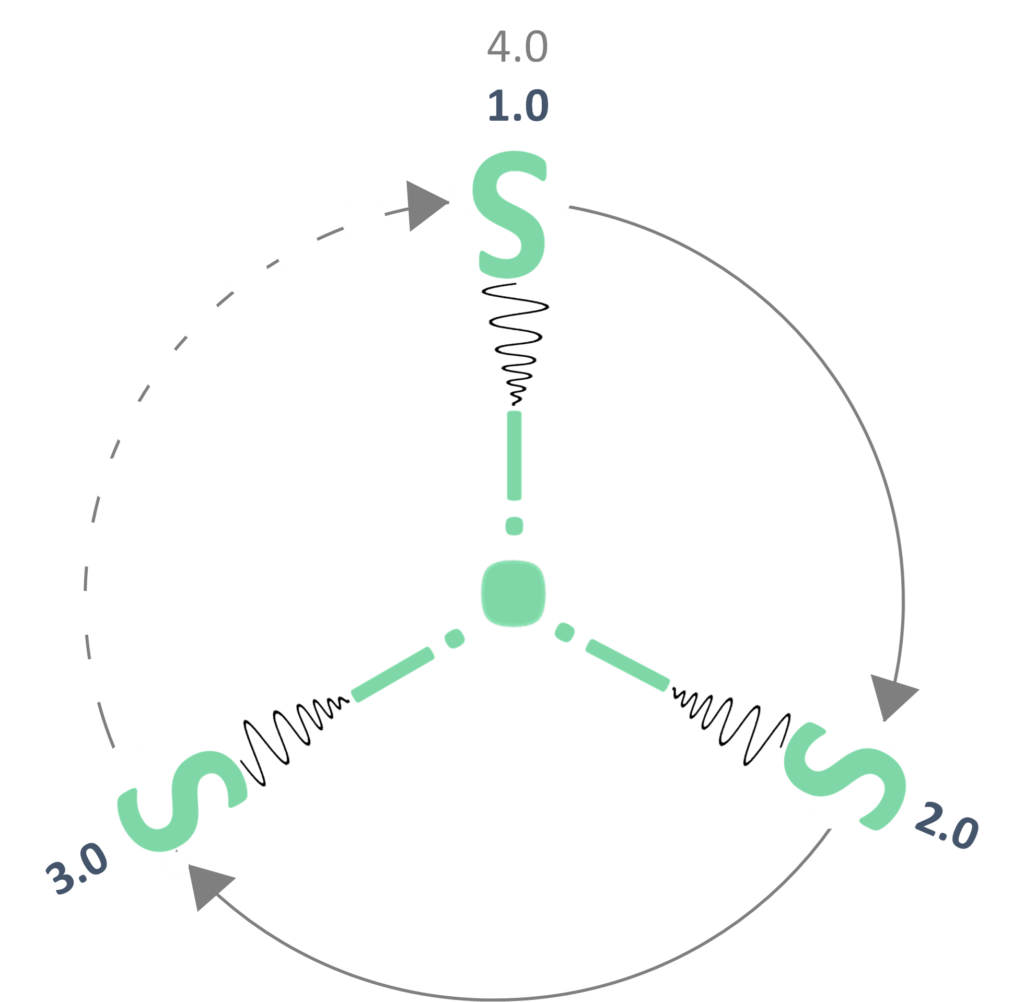
Create the conditions for effective ideation and iteration cycles, ensuring that individual, pair-based, and collective activities follow best practices to maximise creativity and generate valuable insights.
Key Activities
1. Individual Iideation and iteration cycles
2. Group feedback, ideation and iteration cycles
3. Team voting on the best ideas
4. Selection of ideas for further development or testing
Deliverables
1. Ideation results
2. Voting results for best solutions
3. Final decision on solutions for further development and testing
Detailed view and guidance questions
Download PDF
4. Testing and Validation

Goal
Further refine the shortlisted solutions in preparation for testing.
Determine the most appropriate approach for testing and evaluating the solutions, ensuring that their feasibility, effectiveness, and alignment with the defined objectives can be assessed.
Key Activities
1. Identify solutions that require further development or testing
2. Conduct testing and validation activitites
3. Decision on final solutions
Deliverables
1. List of aspects requireing further testing
2. Testing plan and results
3. Decision on solutions to implement
Detailed view and guidance questions
Download PDF
5. Implementation
Goal
Define a strategic implementation plan, execute the plan, and monitor its progress to ensure the solution’s effectiveness and alignment with objectives. This includes setting clear goals, identifying risks, engaging key stakeholders, and establishing metrics for success.
Key Activities
1. Design the strategty for implementation
2. Launch and manage the implementation
Deliverables
1. Strategy for implementation.
2. Approval by sponsors
3. Execution and roll out
Detailed view and guidance questions
Download PDF
FAQs
1. Why another model for complex challenges?
This framework is not intended to replace established models for understanding complexity or developing solutions. Instead, it provides a coherent process within which any model can be applied.
The novelty of this approach lies in the following aspects:
- It functions as a meta-framework. It provides an overarching structure within which other approaches can be selected, combined, and applied coherently. Rather than prescribing one fixed method, it helps teams choose and use suitable models at the appropriate point, such as systems mapping, stakeholder analysis, design thinking, risk assessment, or technical problem-solving.
- It places strong emphasis on creativity and collaboration: the framework positions the creative process—both individual and collective—as a central element of the journey. It proposes an approach that leverages the interplay between creativity and the subconscious to maximise team discovery and ideation and to drive new impulses forward.
- It supports iteration across phases, not only within them. Complex challenges rarely follow a linear sequence from problem definition to solution. Important information may be incomplete at the outset, and a shared understanding often develops over time. The framework therefore invites teams to revisit previous phases in light of new discoveries and insights.
- It is guided by questions rather than fixed activities. Each phase is defined by the key questions that need to be answered, rather than by a mandatory set of tools or deliverables. This enables the project team to determine the appropriate depth and scope for each phase.
2. Why is it called a “journey” rather than a framework?
Although it has the structure of a framework, it is described as a journey to emphasise that the process is exploratory, adaptive, and non-linear. This is a normal characteristic of complex problems. As new challenges, perspectives, and approaches emerge, it may be necessary to revisit earlier phases and reconsider previous assumptions. This mirrors my experience of how complexity is unravelled: by moving through it until understanding of its causes, consequences, and viable solutions increasingly deepens.
The term “journey” highlights that:
- Understanding develops progressively.
- The process may move forwards, backwards, or sideways.
- The destination may become clearer only through exploration.
- Different stakeholders may perceive the same situation in different ways.
- Rational analysis, instinct, experience, and subconscious insights all contribute to the process.
- The framework supports navigation through uncertainty and the unknown.
3. What kinds of issues and challenges is the framework intended to address?
The framework is intended for situations where the problem is complex, uncertain, evolving, or influenced by multiple perspectives.
It is particularly useful when the challenge cannot be resolved through a straightforward solution. This applies to personal self-discovery, interpersonal dynamics, or challenges within groups.
It is most valuable when there is a need to develop not only a solution, but also a deeper understanding of the context in which that solution must work.
Potential applications include:
- Organisational and systemic challenges.
- Sustainability and transformation initiatives.
- Problems involving multiple stakeholders with different interests or interpretations.
- Situations where the underlying problem is unclear or continually changing.
- Innovation and product or service development.
- Strategy formulation and organisational decision-making.
- Conflicts, competing priorities, and difficult trade-offs.
- Projects involving uncertainty, ambiguity, or incomplete information.
- Challenges that require both analytical reasoning and creative exploration.
- Situations where proposed solutions need to be tested, adapted, and reconsidered
4. Where can I find practical guidance and examples of how the framework has been applied?
Further practical guidance and examples are available in the Resources section below. These materials illustrate how the framework can be used in practice.
The examples are intended to support application rather than prescribe a single way of working. Each journey may need to be adapted to the specific context, the people and challenges involved, and the time and dedication that the owner and stakeholders are willing to invest.
Share your experience: If you have examples of how you used the framework yourself, please share them with us! We will post them here to inspire others. We also welcome your feedback on how this framework or our guidance documents can be improved.
If you have questions, please contact us.